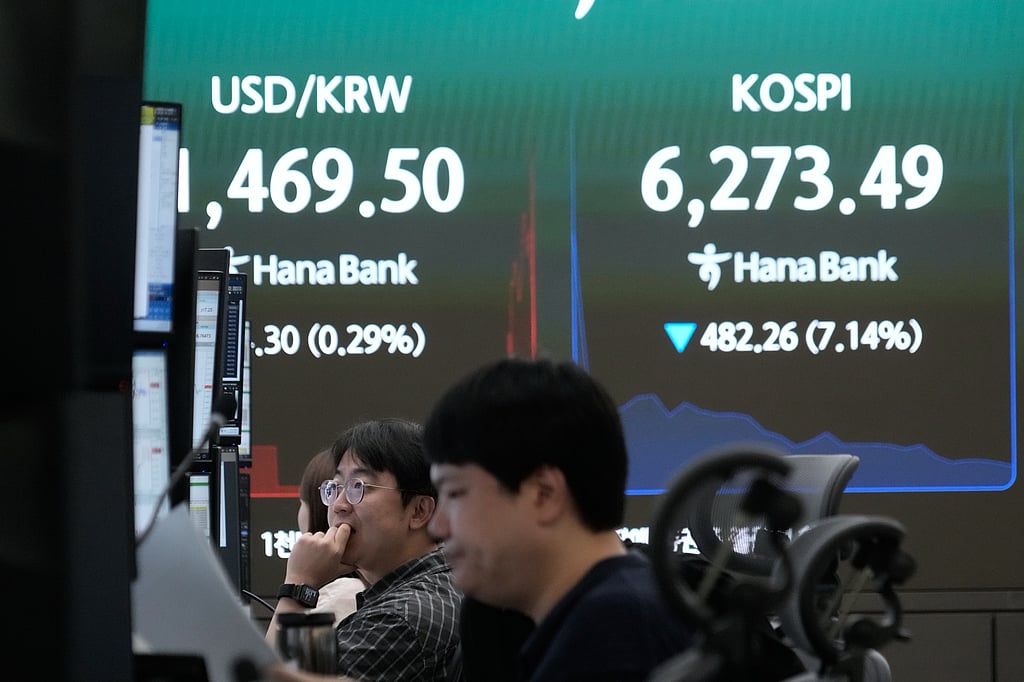
In July 2026, South Korea’s benchmark KOSPI index experienced one of the most violent drawdowns in its history, as the market was heavily influenced by AI euphoria After surging to an all-time peak above 9,100 points in June—riding a massive global wave of artificial intelligence euphoria—the KOSPI plummeted nearly 27% in less than a month.
The selloff erased roughly ₩250 trillion ($180+ billion) in market capitalization and activated market-wide circuit breakers seven times in a matter of weeks.
| Metric | Details |
| Peak (June 2026) | ~9,114–9,385 points |
| Trough (July 2026) | ~6,806 points (-27%) |
| Market Value Erased | ~₩250 trillion |
| Trading Halts | 7 Circuit Breakers Triggered |
While market panics often appear sudden, the July 2026 Korean stock market crash was the result of multiple compounding structural, technical, and macroeconomic pressures, including the margin call mechanism and leveraged ETFs.
1. The AI Reality Check: Peak Semiconductor Expectations
For the first half of 2026, South Korean equities were the primary global vehicle for AI investment. The market heavily priced in continuous, exponential demand for high-bandwidth memory (HBM) and next-generation DRAM chips. However, sentiment shifted rapidly in late June and early July:
-
CapEx vs. ROI Concerns: Global technology firms faced growing skepticism from institutional investors regarding whether multi-billion-dollar infrastructure investments in AI were translating into immediate corporate revenue.
-
DRAM Price Softening: In June 2026, global DRAM export prices recorded their first monthly decline (-4%) in nearly a year. This signaled potential oversupply and sparked fears that memory chip earnings had reached a cyclical peak.
-
Unforgiving Valuations: Despite strong quarterly earnings reports from semiconductor manufacturers, stock prices failed to meet ultra-aggressive earnings growth models, triggering sharp "sell-on-news" profit-taking.
2. The "Two-Stock Paradox": Extreme Index Concentration
South Korea’s benchmark index suffers from a distinct concentration vulnerability. Two memory chip giants—Samsung Electronics and SK Hynix—account for nearly half of the total market weight of the KOSPI.
| KOSPI Market Component | Index Weight (%) | Market Cap Significance |
| Samsung Electronics & SK Hynix | ~45% – 50% | Heavyweight semiconductor duo driving primary market direction |
| All Other KOSPI Components | ~50% – 55% | Remaining ~800+ listed companies combined |
When global tech funds began trimming exposure to hardware manufacturers, the selling was heavily concentrated in these two titles. SK Hynix fell over 50% from its June peak, while Samsung Electronics plunged more than 40%. Because of their dominant weighting, heavy single-day declines in these two stocks mechanically dragged the broader KOSPI down by 5% to 10% in individual sessions.
3. The Leveraged ETF Liquidation Cascade
Technical leverage converted a standard market correction into a full-scale liquidity crisis.
Earlier in 2026, local regulators approved single-stock leveraged ETFs, enabling Korean retail investors (“Ants”) to amplify bets on major domestic technology stocks. As memory chip prices began to slide:
-
Margin Calls: Falling stock prices breached minimum collateral requirements, issuing automated margin calls to leveraged accounts.
-
Forced Liquidations: Brokers automatically sold underlying equity positions to meet margin deficits.
-
Mechanical Rebalancing: Leveraged and inverse ETFs were forced to sell shares into a falling market at market close to maintain target leverage ratios.
This created a feedback loop where automated selling triggered further price drops, prompting secondary margin calls and driving volatility indices to levels not seen since 2008. Over ₩13.8 trillion ($9.7 billion) in retail capital was liquidated during the collapse.
4. Institutional Rebalancing: NPS Allocation Caps & Foreign Flight
Institutional behavior added significant structural selling pressure:
-
National Pension Service (NPS) Cap: South Korea’s largest institutional investor, the NPS, operates under a strict mandate capping domestic equity allocation (set around 28.8%). The historic rally during early 2026 pushed the pension fund’s domestic holdings far above its legal threshold. In July, the NPS resumed mandatory portfolio rebalancing, offloading tens of trillions of won in domestic equities into an already weakening market.
-
Foreign Capital Outflows: Global macroeconomic funds executed a synchronized risk-off strategy, dumping over ₩170 trillion ($110+ billion) in South Korean equities during 2026, with the vast majority concentrated in July semiconductor sales.
5. External Macro Shocks and Geopolitical Spikes
External macroeconomic shocks further undermined investor confidence in mid-July:
Middle East Escalation -> Oil Price Spike -> Inflation & Rate Fears -> Capital Outflows
-
Energy Price Surges: Geopolitical conflict in the Middle East sparked energy supply concerns, causing global crude oil prices to jump. As a nation heavily reliant on energy imports, South Korea faced immediate headwinds from rising input costs and currency depreciation.
-
Interest Rate Expectations: The spike in oil prices stoked fears of sticky global inflation, delaying expected interest rate cuts by central banks and strengthening the U.S. dollar relative to the Korean won.
Summary of Crash Drivers
| Factor | Mechanism | Market Impact |
| AI CapEx Skepticism | Uncertainty over immediate ROI for AI tech buildout | Softened memory chip demand & lowered valuation multiples |
| Heavy Concentration | Samsung & SK Hynix compose ~50% of KOSPI weight | Chip sector selloff directly crashed the broader benchmark |
| Leveraged ETFs | Mandatory rebalancing & retail margin liquidations | Accelerated downward momentum & spiked market volatility |
| NPS Rebalancing | Mandatory reduction of domestic stocks to meet 28.8% cap | Created tens of trillions of won in institutional overhang |
| Geopolitical Shocks | Oil price surges and foreign exchange pressure | Broader macro risk-off sentiment across Asian emerging markets |
Outlook: Structural Flaw or Cyclical Reset?
The July 2026 KOSPI crash serves as a textbook study in how market concentration, financial leverage, and rigid institutional mandates can turn a valuation correction into a severe market event.
While short-term technical indicators reached extreme oversold territory—pushing 12-month forward P/E ratios to historically low levels—the event highlighted the need for market structure reforms in South Korea. Regulators and global funds are now closely monitoring leveraged product frameworks, market concentration risk, and institutional rebalancing mechanisms to prevent similar cascades in the future.




&w=256&q=75)