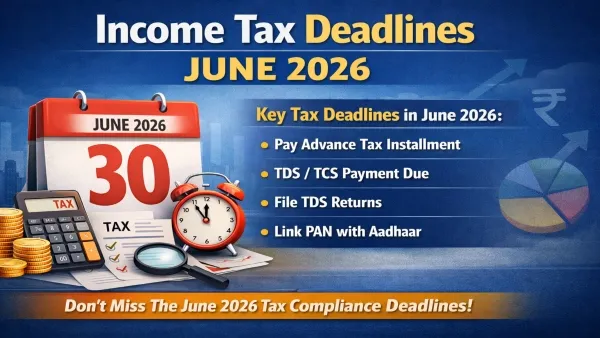
The e-filing portal is active for Financial Year (FY) 2025-26 / Assessment Year (AY) 2026-27. While it might be tempting to get your tax filing out of the way as quickly as possible, rushing through the process is a surefire way to attract tax notices, calculation errors, or missed refunds.
Furthermore, while a newly proposed Income Tax Act is on the horizon, your filing for income earned between April 1, 2025, and March 31, 2026, strictly follows the rules of the existing Income Tax Act.
To ensure a seamless, error-free submission, here are the top 10 critical checkpoints you must verify before you e-verify your return.
1. The Golden Rule: Wait Until Mid-June
Don’t file your returns in a hurry in April or May. Employers have until May 31 to submit their TDS (Tax Deducted at Source) returns and issue Form 16. Similarly, banks and financial institutions update their tax statements around the same time. Filing early means you risk missing out on reflected TDS, which can result in a lower refund or a mismatch notice.
2. Reconcile Form 26AS and AIS/TIS
Your Form 26AS is your official tax ledger, but the Annual Information Statement (AIS) and Taxpayer Information Summary (TIS) capture a much broader view of your financial footprint. You must ensure that the salary earned, bank interest, dividend payouts, and TDS match perfectly across all three documents. If you spot an error in your AIS (like an incorrect transaction attribution), use the online feedback mechanism to correct it immediately.
3. Choose the Right Tax Regime: Old vs. New
For FY 2025-26, the New Tax Regime remains the default option. If you want to stick with the Old Tax Regime to claim deductions like Section 80C (PPF, ELSS, life insurance), Section 84D (health insurance), or HRA (House Rent Allowance), you must explicitly opt out of the new one. Salaried individuals can make this choice at the time of filing, but those with business or professional income must file Form 10-IEA before the due date.
4. Report All Sources of Income (Even "Exempt" Ones)
Taxpayers often forget to declare income that isn't their primary salary. You are legally required to report:
- Interest earned on savings accounts and fixed deposits (FDs).
- Dividend income from shares or mutual funds.
- Minor child’s income (if clubbed with yours).
- Exempt income (like PPF interest or agricultural income) in the designated schedule.
5. Calculate Capital Gains Mindfully
If you sold equity shares, mutual funds, gold, or property during FY 2025-26, you must accurately report your Capital Gains. Ensure you calculate:
- Short-Term Capital Gains (STCG): Assets held for less than the specified threshold (e.g., 12 months for listed equities).
- Long-Term Capital Gains (LTCG): Note the grandfathering clauses and specific exemptions available under sections like 54 or 54F if you reinvested the proceeds from property sales.
6. Declare Foreign Assets and Foreign Income
If you hold global shares (like US stocks or RSUs from a multinational employer), foreign bank accounts, or any property overseas, you must disclose them in the Schedule FA (Foreign Assets). Even if these assets don't generate taxable income right now, failure to disclose them carries severe penalties under the Black Money Act.
7. Match Form 16 data with your Form 12BB disclosures
Review the Form 16 provided by your employer against the investments you originally declared via Form 12BB at the start of the financial year. If you missed submitting a proof to your HR (like a rental receipt or premium receipt), you can still claim it directly on the ITR portal while filing, provided you hold valid documentation to back it up in case of an audit.
8. Cross-Verify High-Value Transactions (SFT)
The Income Tax Department keeps a close eye on High-Value Transactions through Statement of Financial Transactions (SFT) data sent by banks, registrars, and credit card companies. If you made large cash deposits, purchased luxury goods, invested heavily in mutual funds, or cleared credit card bills exceeding ₹10 Lakhs in the year, make sure your declared income logically aligns with these expenditures.
9. Pre-Validate Your Bank Account for Refunds
An overlooked step that stops refunds in their tracks is an unvalidated bank account. Ensure that the bank account where you expect your refund is fully pre-validated on the e-filing portal. Additionally, your PAN must be linked with your bank account, and the name on your PAN card must match the name in your bank records exactly.
10. Don't Forget to E-Verify Your Return
Your ITR filing process is incomplete without verification. Once you submit the return, you have a strict 30-day window to e-verify it (using Aadhaar OTP, Net Banking, or EVC). If you miss this deadline, your ITR will be treated as invalid ("not filed"), which can lead to late fees, interest on outstanding tax, and a complete freeze on any tax refunds.



&w=256&q=75)